The Improper Integral Comparison Tests are the Direct Comparison Test and the Limit Comparison Test
These tests can help you determine wheter or not an improper integral covnerges or diverges
These also allow you to solve integrals you wouldn't be able to otherwise by comparing to a simpler integral
Direct Comparison Test (DCT)
Let $f(x)$ and $g(x)$ be positive and continuous on $[a,\infty)$
If $g(x) \geq f(x)$, then
$$\begin{align} \int_{a}^{\infty}{f(x) \ dx} \text{ Converges if } \int_{a}^{\infty}{g(x) \ dx} \text{ Converges} \\ \int_{a}^{\infty}{g(x) \ dx} \text{ Diverges if } \int_{a}^{\infty}{f(x) \ dx} \text{ Diverges} \end{align}$$
Limit Comparison Test (LCT)
Let $f(x)$ and $g(x)$ be positive and continuous on $[a,\infty)$
If
$$\begin{align} \lim_{x \to \infty} \frac{f(x)}{g(x)} = L \end{align}$$
Where $L$ is a positive, finite number ($0 < L < \infty$), then
$$\begin{align} \int_{a}^{\infty}{f(x) \ dx} \text{ And } \int_{a}^{\infty}{g(x) \ dx} \text{ either both converge or diverge}\\ \end{align}$$
Why These Work
If one function is always greater than another function after some point, then the area under is also greater
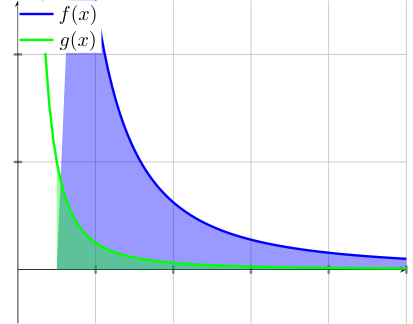
Another core idea is that if an area is smaller than another convergent area, then it should also be convergent
Similarly, if an area is larger than another divergent area (infinite area), then it should also be divergent
Also, if we are larger than a convergent area or smaller than a divergent area, that means nothing
Larger than a convergent area could also be convergent, or it could be infinity
Similarly, smaller than a divergent area can also be infinity or it could convergent
For the limit comparsion test, think about what happens at limits at infinity
Since both $f(x)$ and $g(x)$ are positive, the limit should never hit $-\infty$
If we get $0$, that means $g(x)$ grows faster, which once again tells us nothing
If we get $\infty$, that means $f(x)$ grows faster, which once again tells us nothing
If we get a finite number, that means $f(x)$ and $g(x)$ grow at the same rate, so they are proportional ($f(x) \propto g(x)$)
This means they must have the same end behavior
Practice Problems
-
Determine if $\int_1^\infty{\frac{1}{x^3 + 1} \ dx}$ Converges or Diverges
We could solve this using partial fraction decompisition, but it's easier to compare instead
$$\begin{align} \int_1^\infty{\frac{1}{x^3 + 1} \ dx} \end{align}$$
$$\begin{align} x^3 + 1 &> x^3 \\ \frac{1}{x^3 + 1} &< \frac{1}{x^3} \\ \end{align}$$
$$\begin{align} \int_1^\infty{\frac{1}{x^3} \ dx} &= \lim_{t \to \infty}\int_1^t{\frac{1}{x^3} \ dx} \\ &= \lim_{t \to \infty}\left[-\frac{1}{2x^2}\right]_1^t \\ &= \frac{1}{2} \end{align}$$
Since the integral we compared with converges and is larger, the original integral converges
-
Determine if $\int_1^\infty{\frac{\sin^2(x)}{x^2} \ dx}$ Converges or Diverges
This integral we can't solve so we have to compare
$$\begin{align} \int_1^\infty{\frac{\sin^2(x)}{x^2} \ dx} \end{align}$$
$$\begin{align} 0 \leq \sin^2(x) &\leq 1 \\ \frac{\sin^2(x)}{x^2} &\leq \frac{1}{x^2} \\ \end{align}$$
$$\begin{align} \int_1^\infty{\frac{1}{x^2} \ dx} &= \lim_{t \to \infty}\int_1^t{\frac{1}{x^2} \ dx} \\ &= \lim_{t \to \infty}\left[-\frac{1}{x}\right]_1^t \\ &= 1 \end{align}$$
Since the integral we compared with converges and is larger, the original integral converges
-
Determine if $\int_1^\infty{\frac{e^{-x}}{\sqrt{x}} \ dx}$ Converges or Diverges
This integral we can't solve so we have to compare
$$\begin{align} \int_1^\infty{\frac{e^{-x}}{\sqrt{x}} \ dx} \end{align}$$
$$\begin{align} 0 \leq e^{-x} &\leq 1 &&\text{ For all $x > 1$}\\ \frac{e^{-x}}{\sqrt{x}} &\leq \frac{1}{\sqrt{x}} &&\text{ For all $x > 1$}\\ \end{align}$$
$$\begin{align} \int_1^\infty{\frac{1}{\sqrt{x}} \ dx} &= \lim_{t \to \infty}\int_1^t{\frac{1}{\sqrt{x}} \ dx} \\ &= \lim_{t \to \infty}\left[2\sqrt{x}\right]_1^t \\ &= \infty \end{align}$$
Since the function is smaller, but the larger function gave us infinity, we need to compare to somthing else
$$\begin{align} e^{x} &\geq x &&\text{For all $x$}\\ e^{-x} &\leq \frac{1}{x} &&\text{Flip Inequality}\\ \frac{e^{-x}}{\sqrt{x}} &\leq \frac{1}{x\sqrt{x}} \\ \end{align}$$
$$\begin{align} \int_1^\infty{\frac{1}{x\sqrt{x}} \ dx} &= \lim_{t \to \infty}\int_1^t{x^{-3/2} \ dx} \\ &= \lim_{t \to \infty}\left[-\frac{2}{\sqrt{x}}\right]_1^t \\ &= 2 \end{align}$$
Since the integral we compared with converges and is larger, the original integral converges
-
Determine if $\int_2^\infty{\frac{x^2 + 3x + 5}{x^3 + x + 7} \ dx}$ Converges or Diverges
This integral we can solve, but it will be difficult, so we can compare it using the LCT
I will choose to compare with $1/x$ because the leading terms can simplifiy down to it
$$\begin{align} \frac{x^2}{x^3} = \frac{1}{x} \end{align}$$
Remeber when doing the limit, we are diving by $1/x$, which is the same as multiplying by $x$
$$\begin{align} \lim_{x\to \infty}\frac{x^2 + 3x + 5}{x^3 + x + 7} \cdot \frac{x}{1} = \lim_{x\to \infty}\frac{x^3 + 3x^2 + 5x}{x^3 + x + 7} = 1 \end{align}$$
$$\begin{align} \int_1^\infty{\frac{1}{x} \ dx} &= \lim_{t \to \infty}\int_1^t{\frac{1}{x} \ dx} \\ &= \lim_{t \to \infty}\left[\ln(|x|)\right]_1^t \\ &= \infty \end{align}$$
Since the limit result is finite, the integrals are proportional, and since one of them diverges, the original integral diverges